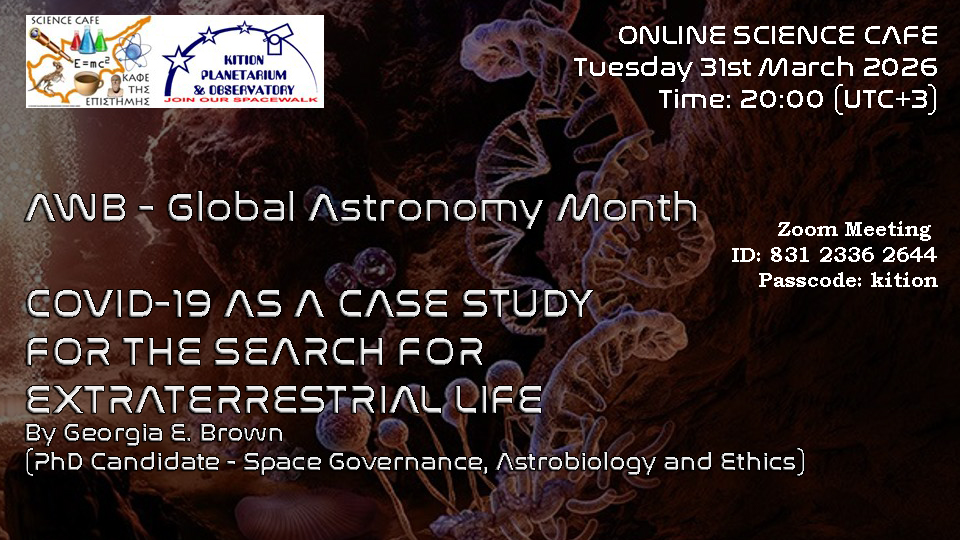
ONLINE SCIENCE CAFE
TUE 31ST MARCH 2026 TIME:20:00 (UTC+3)
Join Zoom Meeting
Meeting ID: 831 2336 2644
Passcode: kition
20:00 WELCOMING BY THE DIRECTOR (GEORGE TROULLIAS)
20:05 AWB GLOBAL ASTRONOMY MONTH - ANNOUNCEMENT
20:10 "COVID-19 AS A CASE STUDY FOR THE SEARCH FOR EXTRATERRESTRIAL LIFE" (GEORGIA E. BROWN)
GUEST SPEAKER - GEORGIA E. BROWN - PhD Candidate - Space Governance, Astrobiology and Ethics

Georgia E. Brown
Georgia is a first year PhD student at Northumbria University in Newcastle in the UK.
Her bachelor’s degree was in Biology with Science and Society at the University of Manchester.
She worked as an Astrobiology researcher with the UK Centre for Astrobiology at the University of Edinburgh
looking at potential fossilised life on Mars and the risk of false positives.
She also holds a Master’s of Law in Space Law from Northumbria University where she has remained for her doctorate.
Recently, she has given talks at COSPAR Symposium in Nicosia, Cyprus and more recently at Leiden University
discussing Earth-Space sustainability and the discovery of extraterrestrial life.
Her project focuses on microbial extraterrestrial life and how we might manage this discovery in terms of rights,
resource utilisation and planetary protection. Mostly, it discusses how we frame this discovery
and how public perception may shape future space activities and exploration.
Her interdisciplinary work combines astrobiology, philosophy and ethics and draws upon legal instruments
from international, environmental, animal and space law.
Visit Georgia's E. Brown Profile on LinkedIn
ABSTRACT
COVID-19 as a Case Study for the Discovery of Extraterrestrial Microbial Life.
The COVID-19 pandemic was a significant event which required a global response to a pathogenic virus.
This event was not just a medical or scientific crisis but relied on politics and required an interdisciplinary approach.
Several years onwards, academics and governments continue to reflect on the lessons learnt from this event.
This paper uses the COVID-19 pandemic as a case study for the discovery of extraterrestrial life, particularly microbial lifeforms.
It investigates the reciprocal relationship between science and policy making in the pandemic drawing on the example of
the World Health Organisation (WHO) Pandemic Agreement and what this reveals about the making of international agreements in the modern world.
It highlights the necessity for international collaboration but recognising that potentially lower stakes
and slower scientific investigatory processes may not provoke the same urgency as seen during COVID-19.
Additionally, the challenge of effective information broadcasting and online (mis)information was rife in the pandemic.
Therefore, by looking at perceptions shaped by science fiction and conspiracy theories about extraterrestrial life
make this case study particularly relevant, providing a valuable analogy for understanding and providing effective science communication.
The paper concludes with addressing the utmost importance for planetary protection
and ratifications of protocols such as those from the likes of COSPAR.
This research does not assume that potential life will be of pathogenic nature but if it is revealed to be harmful to terrestrial life,
the parallels addressed in the research could prove to be even more applicable.
The discovery of extraterrestrial life will have both scientific and political implications
and will carry many of the same political and societal challenges as the COVID-19 pandemic.
The post-pandemic lessons can highlight challenges to be avoided in future global events such as the discovery of extraterrestrial life.
As humanity continues to explore the cosmos and develop an understanding of habitability in space and astrobiology,
precautionary preparations for a discovery must be initiated, not only from a scientific perspective,
but a political one too and the interaction of how their logics and values can inform and influence one another.
Join us to learn more...
Join Zoom Meeting
Meeting ID: 831 2336 2644
Passcode: kition
All meetings of Science Café sessions are free of charge and everyone can join.
Codes and info for the meeting are published here.
Records of previous Online Science Cafés are available at our YouTube channel.
If you have any querries or suggestions, do not hesitate to contact us via e-mail or call +357 9999 1111.
LINKS:
Join Zoom Meeting
Meeting ID: 831 2336 2644
Passcode: kition |